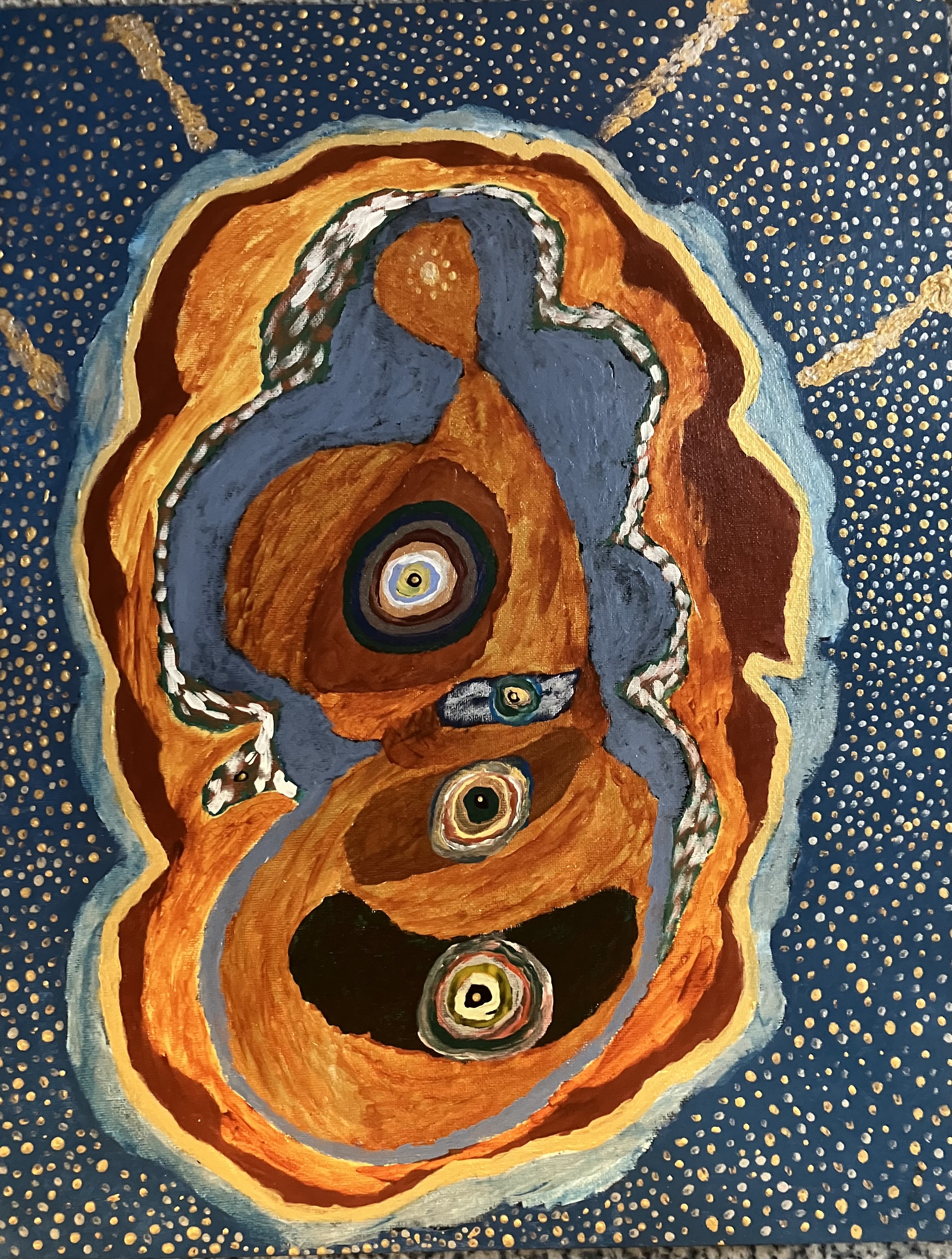
Throughout history, the circle has carried deep symbolic meaning across cultures, philosophies, and spiritual traditions. It is one of the most universal shapes — without beginning or end — representing unity, continuity, and infinite motion.
In art, the circle often becomes a quiet meditation on wholeness. Unlike rigid geometric forms, it suggests movement rather than confinement. It implies cycles rather than linear endings. The sun, the moon, the rhythms of seasons, and even the arc of a human life follow circular patterns. We return, evolve, repeat, and transform.
When used in abstract art, circles can reflect emotional states and energetic shifts. A single line looping back upon itself may represent resilience. Intersecting circles can suggest relationships, shared experiences, or the overlapping nature of identity. Expanding rings might symbolize growth or awareness unfolding outward into the world.
The power of circular imagery lies in its subtlety. It invites contemplation rather than instruction. Viewers often find themselves tracing the motion of the form, unconsciously participating in its rhythm. This quiet engagement creates space for reflection.
Circles also challenge the idea of separation. In a circular system, everything connects. There is no isolated point that stands alone. Each part influences the whole.
As both a visual and philosophical element, the circle reminds us that life is rarely linear. Instead, it moves in spirals of discovery — returning to familiar themes with deeper understanding. In this way, art rooted in circular forms becomes more than decoration; it becomes a meditation on interconnected existence.
Leave a Reply